Forget the canal-cruise bars. The real Amsterdam drink happens in a tobacco-stained bruin café over a beer and a tray of bitterballen, or bent double over a brimming jenever glass in a 1724 proeflokaal. This is the borrel ritual, and it is the city's most honest hour.
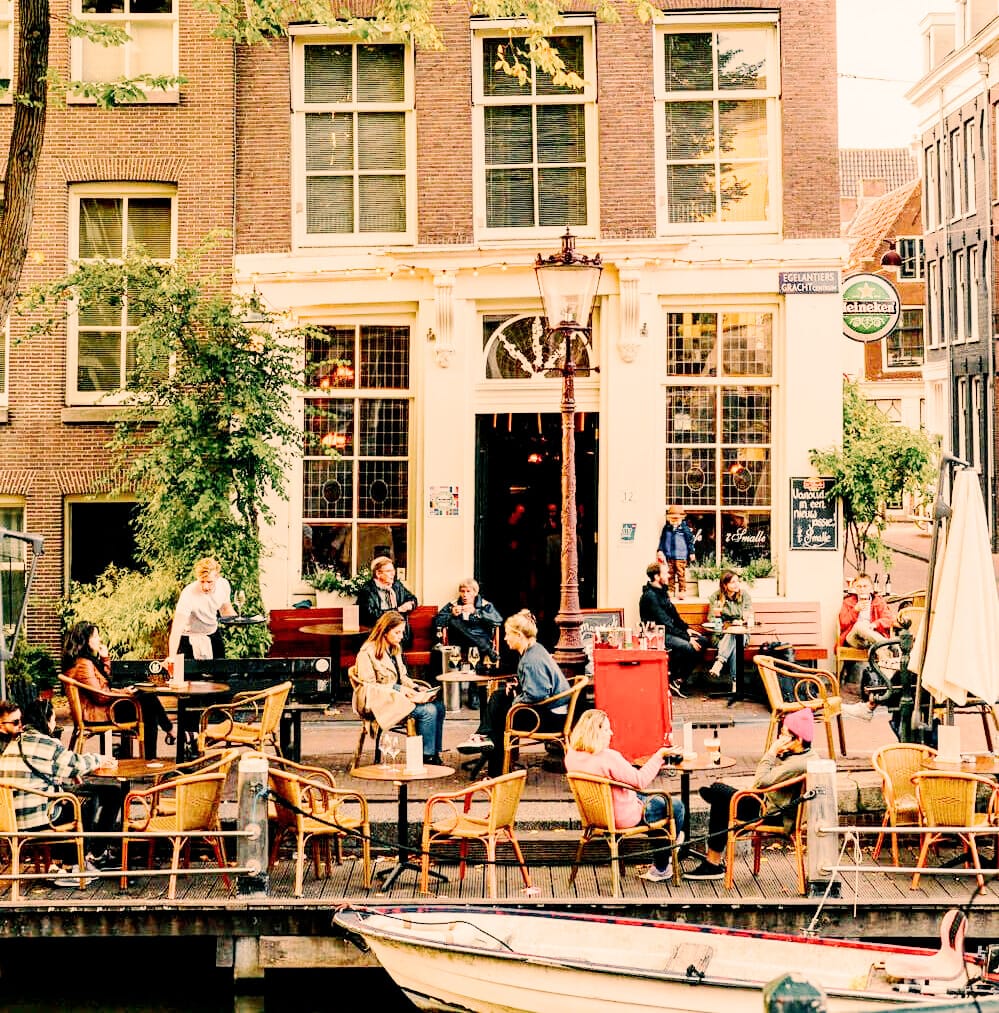
Amsterdam's drinking culture is not built on rooftops or signature cocktails. It is built on the bruin café, the brown café, so named for the centuries of tobacco smoke and candle soot that darkened its walls and ceilings into the colour of strong tea. The genuine ones are not decorated to look old; they are old. Café 't Smalle on the Egelantiersgracht began life in 1786 as a jenever distillery, and its dark wood, stained glass and waterside terrace have survived more or less intact ever since. A few canals north, Café Papeneiland occupies a gabled 1642 house at the corner of the Prinsengracht and Brouwersgracht, its Delft-tiled walls hiding the legend of a secret Catholic passage beneath the floor.
The ritual that fills these rooms is the borrel: the late-afternoon or early-evening drink that is less about getting somewhere and more about being somewhere. You order a small beer or a glass of jenever, a tray of bitterballen arrives with sharp mustard, and the conversation finds its own pace. Nobody is performing. The terrace at Papeneiland faces the water; on a mild evening it is one of the most quietly satisfying seats in the city, and the apple pie is not an afterthought but a reason to stay.
For the drink itself in its purest form, walk down the narrow Pijlsteeg alley off the Dam to Wynand Fockink, a working jenever distillery founded in 1724 inside a 1679 building. Around seventy varieties of jenever and old Dutch liqueurs are still made and poured here in a tiny preserved proeflokaal. The custom is exact: the tulip glass is filled to the brim, you do not lift it with your hands, you bend at the waist and take the first slurp where it stands. It reads as theatre only to those who have never done it; for the regulars it is simply how you greet the glass.
What separates these places from the souvenir version is that the locals are the point, not the backdrop. Café Welling has stood behind the Concertgebouw since 1901 with no concept and no gimmick, just musicians and neighbours filling the worn-in room before and after concerts. Over in Oud-West, Café L'Affiche keeps the same low-key register on a residential corner, the kind of place you end up in rather than seek out.
The lesson for a visitor who wants the real thing is to lower the stakes and slow down. A borrel is not a destination dinner; it is the hour that frames the dinner. Treat the jenever as you would a good rakı table at home — something to be sat with, not knocked back — and the brown café opens up. The walls are dark for a reason. They have been listening for a long time.