A city famous for street food keeps a quieter secret: a serious fine-dining tier, led by a rooftop in Chiaia and a French master at the port. Here is where Naples puts on its evening clothes.
Naples wears its reputation for the popular and the street-level proudly, and that reputation is deserved — but it has flattened the city into a caricature in the outside imagination. The truth is that Naples also keeps a refined table, and over the past decade that high tier has grown genuinely serious: kitchens working at a level that bears comparison with anywhere on the peninsula, often with a view that no kitchen in Milan or Rome can touch. If you want to see the city dressed for the evening, you start at the top of a hotel in Chiaia.
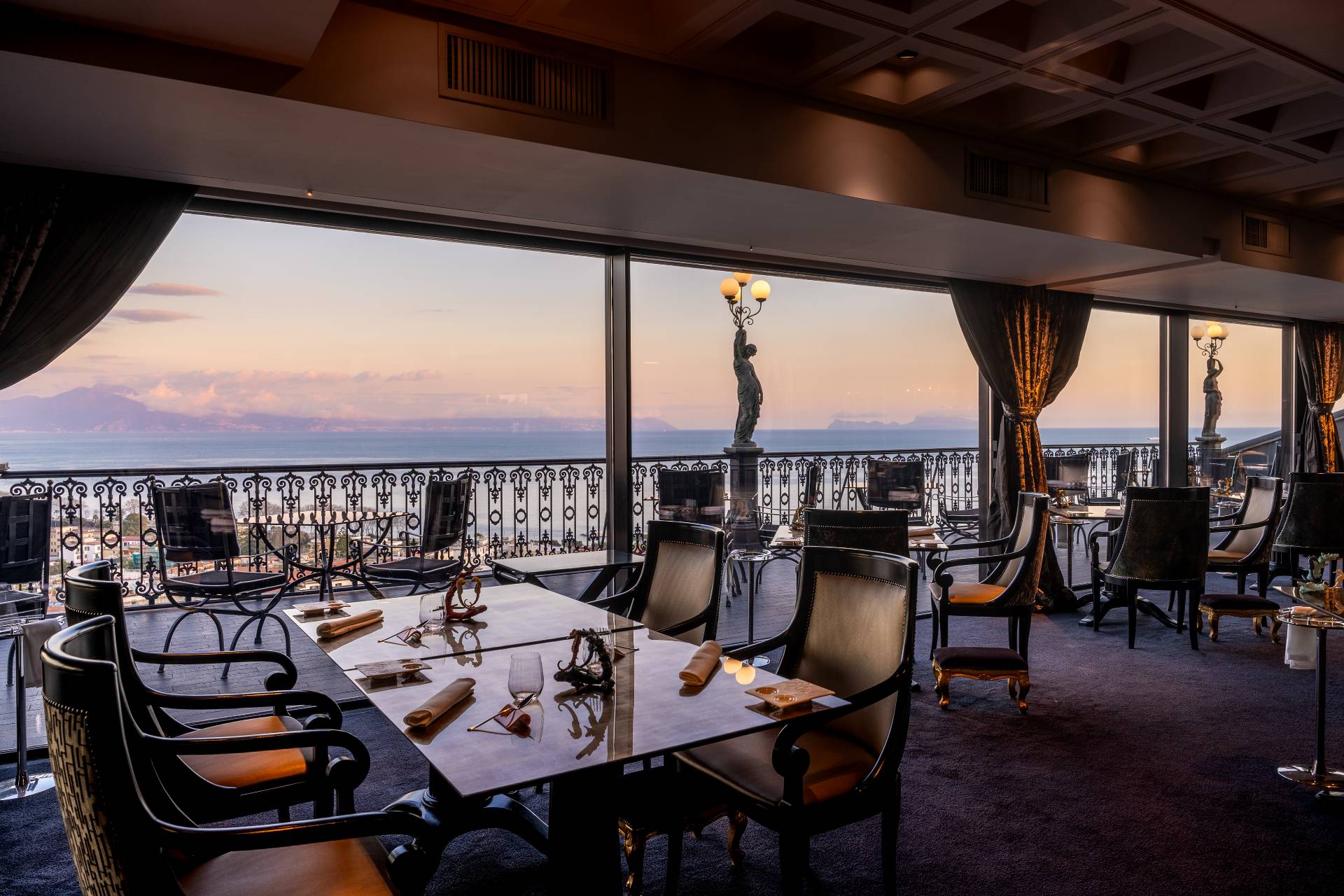
George Restaurant, the rooftop of a grand hotel above Chiaia, is the obvious anchor — a refined, chef-driven Campanian kitchen with a tasting menu and a terrace that looks out across the whole sweep of the bay to Capri and Vesuvius. It is the rare destination restaurant where the view would justify the visit on its own and then the food refuses to be upstaged by it. This is Campanian cooking elevated rather than reinvented: the region's produce and seafood treated with technique and restraint, in a room built for an occasion. It is where Naples sends you when the dinner is meant to matter.
Down at the port, the city's most internationally credentialed kitchen belongs to a visitor. Il Ristorante Alain Ducasse Napoli brings the French master's haute-cuisine discipline to bear on Mediterranean materials — a precise, formal, luxurious experience inside one of the grand maritime hotels, the kind of cooking that speaks an international fine-dining language while still listening to where it is. It is the most overtly haute address in the city, and it makes an interesting argument against the others: this is what Naples looks like when it borrows the grammar of Paris.
The native answer to that argument is Veritas, in the Centro area — an intimate, contemporary Campanian room that has long carried a star and cooks with a chef's-eye precision and a clear point of view. Where Ducasse imports a tradition, Veritas refines a local one, and the contrast between them is the most interesting conversation in the city's fine dining. Add Aria Restaurant, near the port, where a Sicilian-Campanian sensibility produces elegant, chef-driven plates, and you have a small constellation of kitchens proving that Naples can do quiet, considered, expensive cooking as convincingly as it does the loud and the cheap.
What unites the best of these rooms is that none of them have severed themselves from the place. Even at the most formal table, the langoustine, the sea bream, the San Marzano, the lemon off the Amalfi cliffs are doing the talking. This is the opposite of the rootless luxury you find in international hotel dining elsewhere; here the refinement is in service of the ingredient, not a replacement for it. The technique is imported or invented; the soul is local.
And the tier bleeds pleasantly into the merely excellent. Palazzo Petrucci on the Posillipo waterfront brings modern-Neapolitan ambition without the full formality, and out in Bacoli, Caracòl plates Mediterranean seafood at a fine-dining level with the Campi Flegrei coast as its backdrop. Between the rooftop in Chiaia, the French room at the port, the starred kitchen in the center and the waterfront tables to the west, there is now a complete high-end map of Naples — proof that the city famous for a one-euro pizza can also, when it chooses, set one of the better tables in Italy.