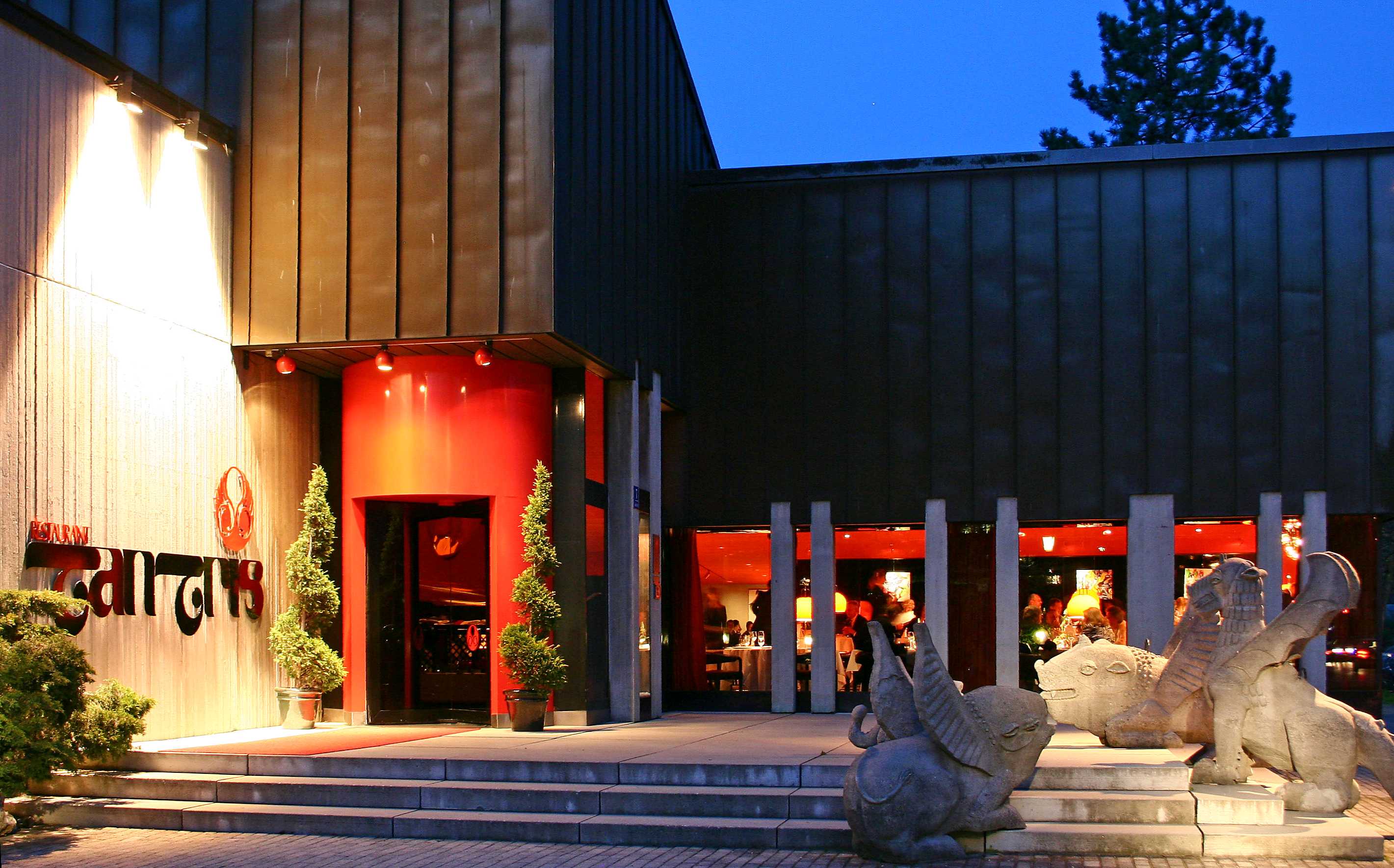
When Tantris opened on Johann-Fichte-Straße in 1971, Munich did not have a fine-dining culture in any modern sense. Fifty-five years later, Benjamin Chmura runs the kitchen of a room that survived its founder, two refurbishments, and the entire German nouvelle-cuisine generation it produced — and the question is no longer whether it matters but what it now means.
When Eckart Witzigmann arrived in Munich in 1971 to open Tantris with the entrepreneur Fritz Eichbauer, German fine dining as a category did not exist. The country had Wirtshaus cooking at one end and hotel-restaurant continental at the other, with very little of substance in between. Witzigmann had trained under Paul Bocuse and the Troisgros brothers in France, and he brought the nouvelle cuisine grammar with him — lighter sauces, vegetables treated as protagonists rather than garnish, the discipline of the tasting menu — into a room on a quiet Schwabing-edge street that Justus Dahinden had designed in a deliberately uncompromising late-modernist register: orange and brown, sculptural columns, lighting that was theatrical without being dramatic. Within two years it had three Michelin stars. Within a decade it was the school every serious German chef wanted on their CV.
The roster of cooks who passed through the Tantris kitchen between 1971 and the early 2000s is, in retrospect, the entire spine of modern German gastronomy. Hans Haas held the kitchen from 1991 to 2020 and steadied the room into its second generation. Heinz Winkler, who succeeded Witzigmann directly, went on to Aschau and his own three-star era. Christian Jürgens, of Überfahrt, learned here. The chefs who eventually opened Steirereck in Vienna and a dozen of the best rooms in Bavaria came through this kitchen first. The Tantris story between its founding and its 2020 closure for renovation is the story of how Germany taught itself to cook at the highest level.
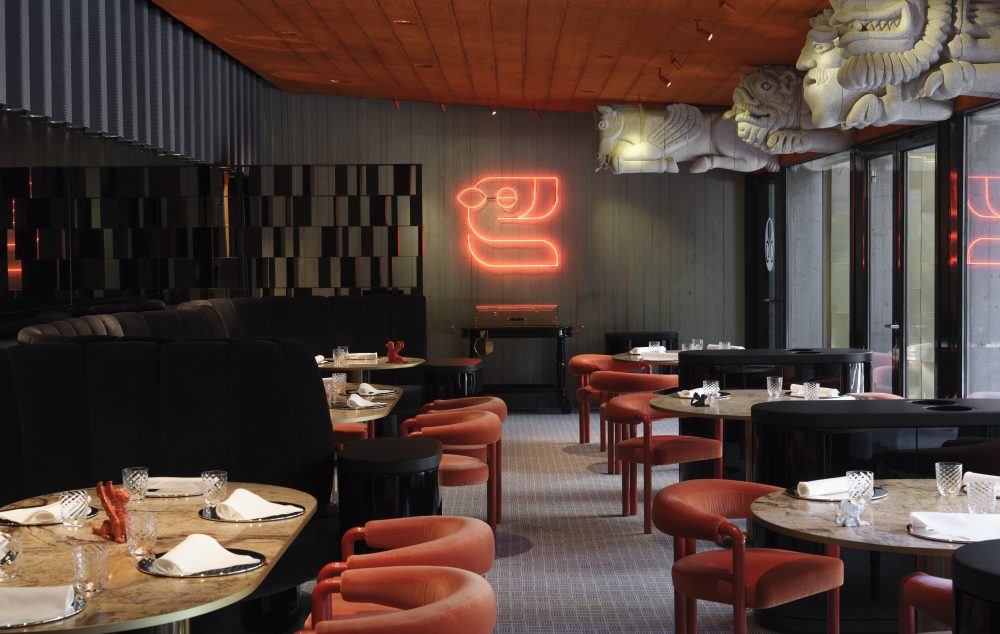
The 2021 reopening was, by any honest reading, a risk. The Eichbauer family had sold the room. The interior was restored under landmark protection — the Dahinden colours and silhouettes preserved with rare discipline — but the kitchen was new: Benjamin Chmura, who had worked under Yannick Alléno in Paris and at Troisgros, took the main room; Virginie Protat, formerly of L'Arpège, opened the casual bistro Tantris DNA next door. Two stars came back to the main room within the first guide cycle. One came to DNA. The Munich critics who had filed the eulogy in 2020 had to write a different kind of piece in 2022.
What Chmura's Tantris is in 2026 is harder to summarise than what Witzigmann's Tantris was in 1971, because the cultural ground has moved. There is no longer one register of haute cuisine to defend; there are twenty, and Tantris no longer needs to be the school. What it is instead is something rarer: a room that remembers. The tasting menu reads as a long argument with the room's own history — French technique handled lightly, ingredient lineage made legible, the occasional gesture toward the kaiseki sensibility that has been part of Tantris's vocabulary since long before German fine dining noticed Japan. The wine list, under sommelier Justin Leone, leans on small Bavarian and Austrian growers in ways that the 1971 list could not have imagined. The service is unhurried in the specific Tantris way, which is to say without ceremony.
For the Istanbul cosmopolitan flying in for two nights, the question is whether Tantris is the right one-meal booking, given that Tohru in der Schreiberei is the only three-star room in the city and JAN is the other. The honest answer is that they do different things. Tohru is a destination booking — the architectural rarity, the chancery walls, the eight-course Japanese-European synthesis at its formal peak. Tantris is a longer answer to a different question. It is what happens when a great room has been a great room for fifty-five years and has had time to think about what it is doing. The dinner is excellent. The room is itself. You leave understanding something about Munich that you cannot learn at a single-evening destination.
Tantris DNA next door is the answer to the lower-stakes booking. Same building, same hospitality, a different and tighter format — five courses or a la carte at the bar — and one Michelin star of its own. The Maxvorstadt curator who eats here on a Tuesday after a Pinakothek hour is the audience the room was designed for; on a one-week trip, DNA is the right midweek booking and the main room is the right end-of-trip one. Both of them belong to the same project. That project is now in its fourth decade and second generation. It is, unmistakably, still working.