The most famous beer hall in the world is the one Münchners least frequent. The real map runs through Augustiner courtyards, a Schneider corner near Tal, and a Paulaner cellar above Giesing — and once you read it, you stop going to Platzl entirely.
There is a tacit agreement among Münchners about Hofbräuhaus that goes unsaid because it does not need to be said: nobody who lives in the city actually goes there. The room is grand, the brass band plays on schedule, the beer is competent, and the courtyard at Platzl is one of the prettier spaces in the Altstadt — but the place exists, in any meaningful contemporary sense, for the cruise passengers and the bachelor parties and the corporate offsites that have been bussed in from the airport. The locals walk past it on the way to somewhere better. The interesting question is not why they avoid it. The interesting question is the map they use instead.
Augustiner-Bräustuben in Westend is the single most useful answer. The building is the original Augustiner brewery, decommissioned for production but still pouring beer drawn directly from wooden gravity barrels — the only way most Münchners think Helles ought to be served. The courtyard fills early on a warm Friday and stays full until midnight; the kitchen does Schweinsbraten and Obatzda and a Schnitzel that has not changed in any meaningful way since the seventies. There are no schedules of brass-band performances. There are no menus in eight languages. Tables are shared without ceremony, the staff reads the room rather than the script, and the beer arrives in a Maß without anyone asking which size you wanted because there is only one size.
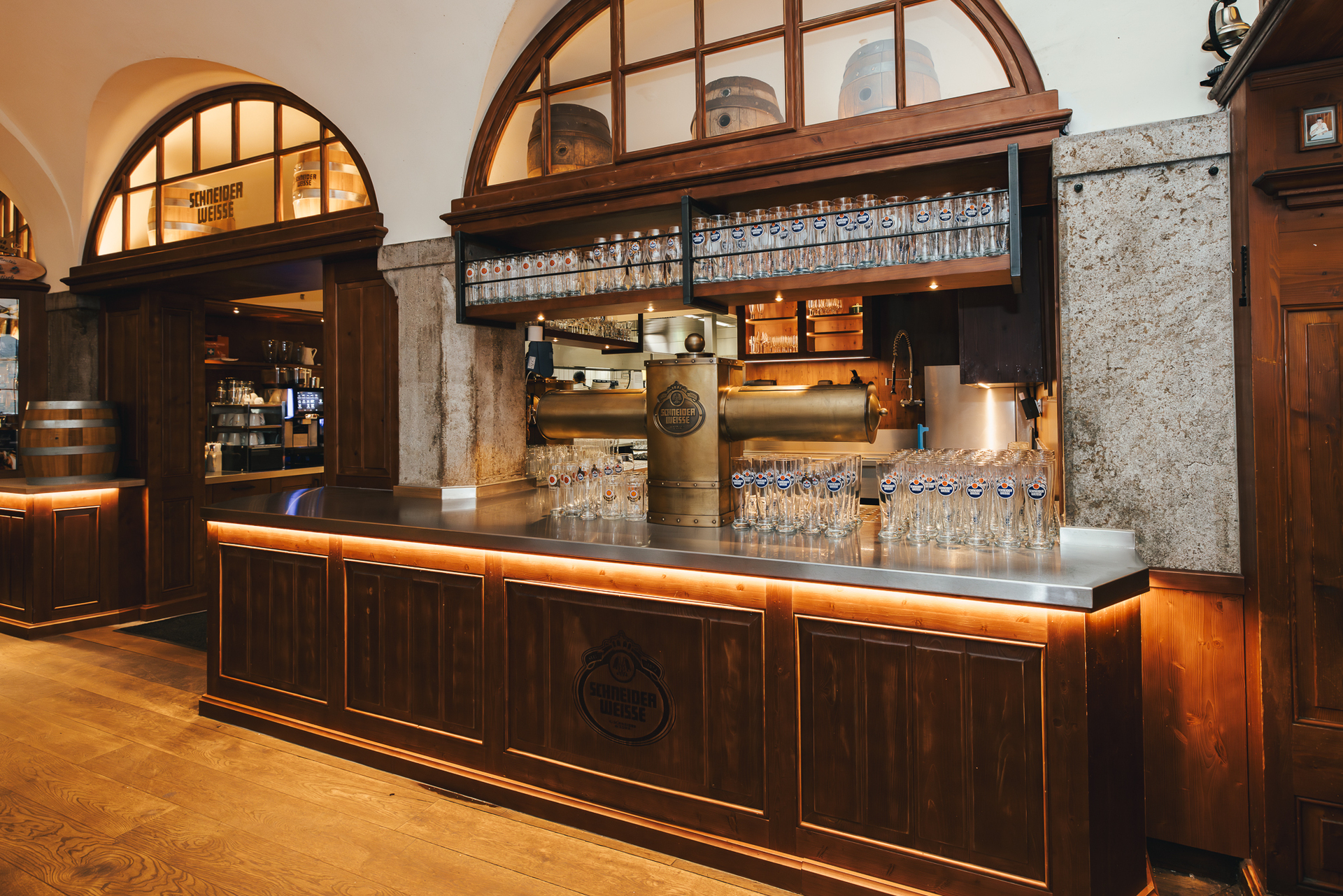
Schneider Bräuhaus, on Tal in the Altstadt, is the wheat-beer counterpart and the closest thing the centre has to a Hofbräuhaus that locals will admit to using. The room has been on this corner since 1872; the menu still leads with Weisswurst before noon and the Schneider Tap series — Tap 1 through Tap 7 — covers a wheat-beer range that no industrial brewery bothers with. Service is brisk in the Bavarian sense, which is to say it works, and the regulars at the long table near the window have been the same regulars for long enough that you sit somewhere else and let them get on with it.
On the other side of the Isar, Paulaner am Nockherberg is the institutional answer for a particular ritual: the Lent strong-beer season. The cellar above the Au-Giesing slope has been the canonical Starkbierfest venue for over a century; when the monks' double-bock tradition turns into Munich's quieter, more local festival in March, the seats here are booked in November. The rest of the year it functions as a generous Bavarian Wirtshaus with a beer garden that catches afternoon sun, a Schnitzel that does what you want a Schnitzel to do, and a clientele that runs from grandfathers in lederhosen to design-school students who came up from Glockenbach for the Helles.
Ayinger in der Au plays a different role: the destination beer hall for people who care which malt is in the glass. The Aying brewery is twenty kilometres south of the city, but its in-Au house pulls the freshest pours of Jahrhundert-Bier and Celebrator anywhere in Munich, served alongside genuinely careful Bavarian cooking — Tafelspitz, Kalbsbeuscherl, the kind of nose-to-tail that has been quietly unfashionable for so long it has become interesting again. The room is wood and white tablecloth; the back garden, when the weather allows, runs onto Mariahilfplatz where the Auer Dult sets up three times a year.
Hofbräukeller am Wiener Platz is the local correction to Hofbräuhaus itself — same brewery, same beer, but in Haidhausen rather than the Altstadt, with the Wiener Platz open-air market at the door and a clientele drawn from the surrounding French-Quarter grid rather than the cruise terminal. This is where Münchners go when they want a Hofbräu Maß and a clean Schweinshaxe in a room that is not a tourist set-piece. The beer garden, at five o'clock on a long June evening, is the version of Munich that the postcards never quite capture.
The lesson behind all of this is the same lesson that the Karaköy chef knows about Sultanahmet, that the Marais native knows about Montmartre: the most photographed venue in any city is rarely the most useful one. The Münchner beer-hall map is a working document. It is built around proximity to where people actually live, around brewers who keep the wooden barrels chilled on site, around courtyards that catch the afternoon and gardens that hold a thousand people without feeling forced. Hofbräuhaus is a postcard. The rest of the map is a city.