The Neapolitan morning is a fixed liturgy: a coffee taken standing, a still-warm sfogliatella, sixty seconds of conversation. Done at the right counters, it is the most civilized thing the city does.
The Neapolitan morning has a shape, and it does not involve sitting down. You walk into a bar, you order a coffee, you take it standing at the counter in two or three short movements, you exchange a sentence with whoever is next to you, and you leave. The whole thing takes ninety seconds and costs less than a euro, and it is one of the most quietly perfect daily rituals anywhere in the world. The trick, for a visitor, is to do it at the counters that have been getting it right for over a century, and to pair the coffee with the pastry the city was built around.
That pastry is the sfogliatella — a shell of shatteringly thin, crisp pastry leaves (the riccia) wrapped around a warm ricotta-and-semolina filling, scented with candied citrus and cinnamon. There is also the smoother frolla version in shortcrust, for those who find the riccia too architectural for breakfast. The single most important fact about a sfogliatella is temperature: it must be warm, ideally just out of the oven, the pastry crackling and the filling soft. A cold one from a glass case is a different and lesser thing, and the great houses know it.
The starting point is Pintauro, on Via Toledo, the pasticceria most often credited with bringing the sfogliatella riccia into the city from the Amalfi coast convent where it was born. It is a small, historic, stand-at-the-counter operation, and the sfogliatella here is the benchmark against which you will measure every other — eaten warm, on your feet, a few steps from the Spanish Quarter. It is less a café than a shrine to a single pastry, and it is the correct place to begin your education.
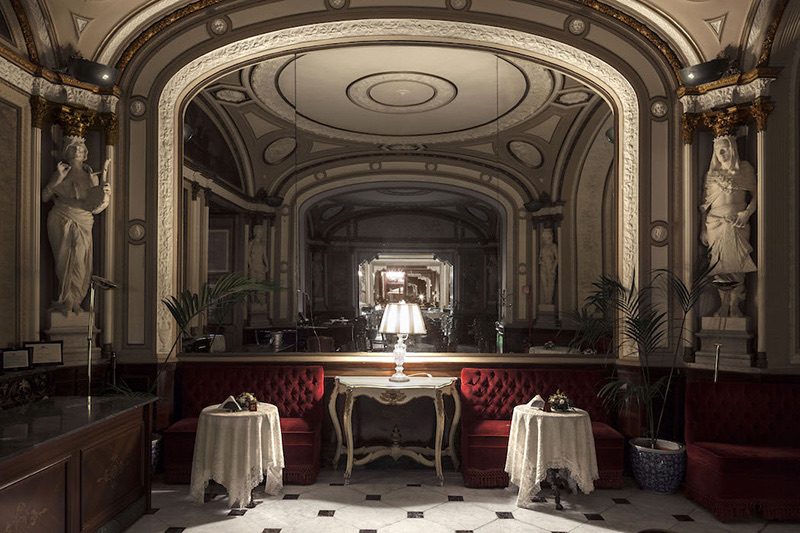
For the morning's other half — the coffee taken as theater — there is only one address, and it is Gran Caffè Gambrinus on Piazza Trieste e Trento. Open since 1860, all gilt and mirrors and marble, it is the historic literary café of Naples, where the city's writers and politicians have argued for a century and a half. You can sit in the grand rooms and pay for the privilege, or — better, and more Neapolitan — you can stand at the bar and take a tight, perfect espresso for the price of a coffee anywhere. Ask, while you are there, about the caffè sospeso, the suspended coffee paid forward for a stranger: the tradition was born in places like this.
From there the city opens into a small circuit of historic pastry houses, each with its champions. Sfogliatelle Attanasio, hidden in the Vasto quarter behind the central station, is the cult address — a tiny, steamy, perpetually busy bakery whose entire reason for existing is the sfogliatella, sold warm by the dozen to a line that never quite disappears. Scaturchio, on the Piazza San Domenico Maggiore in the heart of the Centro Storico, is the grand old name of the historic center, as famous for its chocolate-dipped ministeriale as for its sfogliatelle.
Round out the circuit with Antica Pasticceria Carraturo, near Porta Capuana, another historic neighborhood house with a devoted local following and a sfogliatella worth crossing town for. The pleasure of these places is precisely that they are not interchangeable: regulars hold fierce, specific loyalties, and arguing about whose riccia has the better crackle is itself a Neapolitan pastime. Pick a side by tasting widely.
There is a seasonal coda worth knowing. Around Easter the pastry houses turn to the pastiera, the wheat-and-ricotta tart scented with orange-blossom water that is the great Neapolitan holiday cake; at Carnival the fried chiacchiere and sanguinaccio appear; and the Christmas windows fill with struffoli and roccocò. The everyday ritual — coffee standing, a warm sfogliatella — runs all year. But timing your visit to the calendar of the pasticcerie is how you taste the city at its most generous.