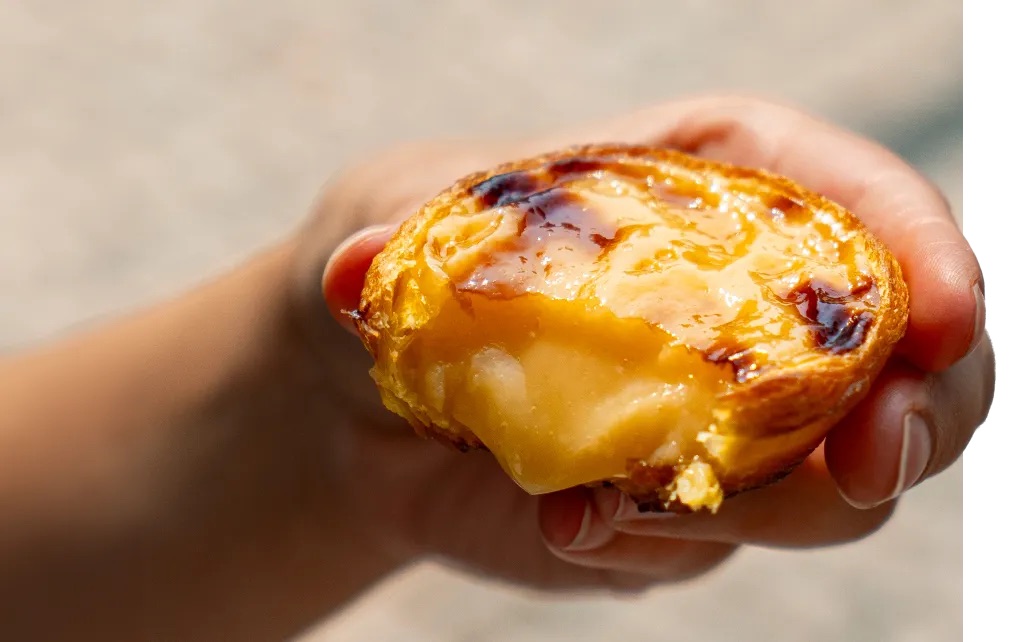
The famous Belém line is a pilgrimage, not a verdict on quality. The best custard tart in Lisbon is the one pulled from the oven thirty seconds before it reaches you, and several counters across the city do that without the wait.
There is one rule that decides everything: a pastel de nata must be eaten warm, the custard still wobbling, the laminated pastry shattering, ideally within minutes of leaving the oven. The queue at the original Belém house guarantees fame and a certified recipe, but it does not guarantee that your tart is warm by the time you sit down with it. Quality is a function of timing, and timing rewards the counters that bake in continuous small batches.
Manteigaria is the city's answer to this. At the Chiado mother house, on the corner of Largo do Chiado in a 1900 building, you watch the tarts go in and out behind glass, and a bell rings when a fresh tray lands. Eat it standing at the marble counter with an espresso, cinnamon shaker in reach. The Belém branch of Manteigaria does the same thing a short walk from the famous queue, with no wait and a tart that is arguably better for being fresher.
For the older, gentler version, Pastelaria Aloma in Campo de Ourique has been baking since 1943 and has repeatedly won the city's best-nata competitions. It is a neighbourhood pastelaria first, a tourist stop never, which is exactly why locals trust it. The pastry is a touch softer, the custard less caramelised, more breakfast than spectacle.
Confeitaria Nacional, on Praça da Figueira, is the historical anchor: family-run since 1829, Lisbon's oldest pastry house, with a gilded room that has fed the city through monarchy and republic. The nata is excellent, but go also for the wider repertoire of conventual sweets and, in winter, for the Bolo Rei. This is where you understand that the nata is one note in a much older Portuguese pastry tradition.
How to do it: treat the nata as a standing ritual, not a sit-down course. One, sometimes two, with a bica, dusted with cinnamon if you like, eaten on your feet at the counter. Resist the boxed dozen until you are leaving the country; they go stale within hours and the magic is in the heat. And remember that a great tart costs around a euro and change anywhere serious, which tells you the inflated tourist-zone prices are buying you a view, not a better pastry.
The honest hierarchy is not Belém versus the rest. It is warm versus cold, fresh versus sitting, neighbourhood counter versus coach-tour stop. Get that right and the queue stops mattering.