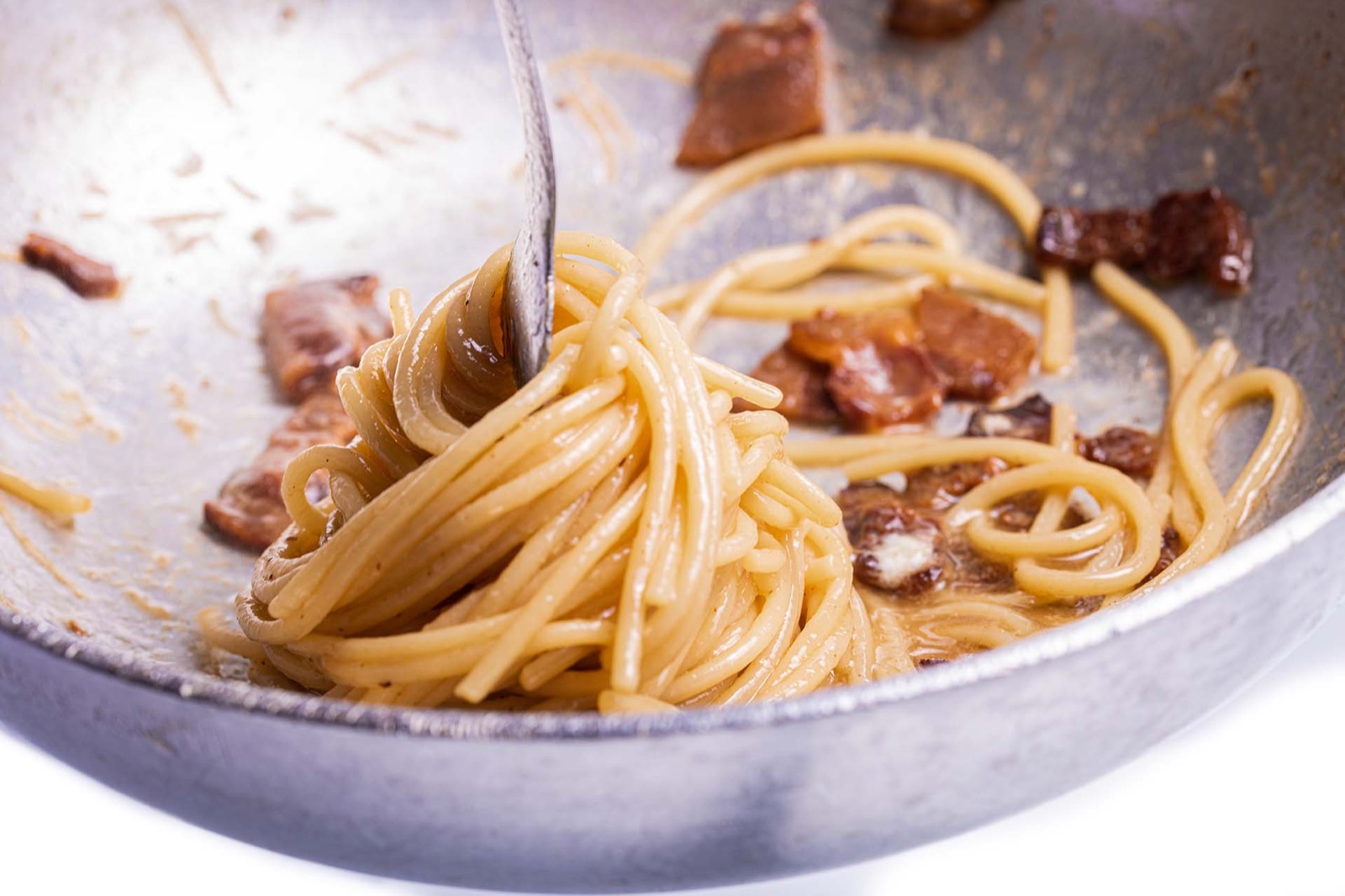
Four pastas hold the city together: cacio e pepe, gricia, amatriciana, carbonara. Get the canon right, guanciale not pancetta, pecorino not parmesan, no cream, ever, and Rome opens up.
There is a temptation, abroad, to treat carbonara as a dish you can improvise around. In Rome it is closer to a creed, and it has a family. The four primi that define the city, cacio e pepe, gricia, amatriciana, carbonara, are variations on a single frugal idea: pecorino romano, black pepper, cured pork cheek, and the starchy pasta water that binds them. Add tomato to gricia and you get amatriciana; add egg yolk instead and you get carbonara. Once you can read that lineage, a menu stops being a list and becomes an argument.
The non-negotiables are worth stating plainly, because Roman kitchens will defend them. Guanciale, the cured jowl, not pancetta or bacon. Pecorino romano, sharp and salty, not parmesan. No cream, the silkiness comes from emulsifying egg and cheese with hot pasta water off the heat, a technique that separates the competent kitchen from the careless one. Get this wrong and a Roman will tell you; get it right and the dish needs nothing else.
For the textbook versions, La Carbonara in Monti carries the name as a standard to live up to, and Trattoria da Danilo near Termini has built a quiet cult around a carbonara finished in a hollowed pecorino wheel, theatrical, yes, but the technique underneath is sound. Armando al Pantheon, a few steps from the monument and run by the same family since 1961, is the rare central address that has refused to drift downmarket: book ahead, because the locals do.
Testaccio, predictably, has the purest reference points. Trattoria Perilli's carbonara is mantecata at the table with the gravity of a ritual, and Flavio al Velavevodetto and Felice a Testaccio both turn out gricia and amatriciana that show you what the canon is supposed to taste like before anyone added complications. For a different angle entirely, Salumeria Roscioli treats the same four pastas as a tasting exercise, plating them with a sommelier's seriousness and a deli's obsession over the cured pork itself.
Order across the family rather than fixating on carbonara alone. A gricia tells you more about a kitchen than a carbonara does, there is nowhere to hide without the egg, and a cacio e pepe reveals whether the cook can emulsify at all. Eat the four in sequence over a few days and you will leave understanding Roman cooking from the inside, which is more than most residents could articulate.