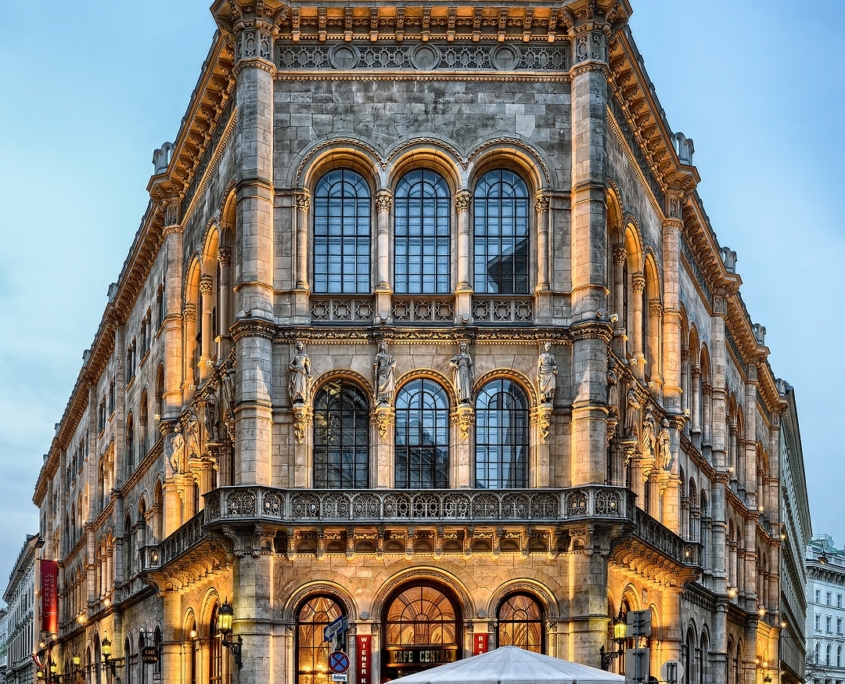
Vienna's kaffeehaus culture is on UNESCO's intangible-heritage list since 2011. The institution that explains the lineage best, Café Sperl in Mariahilf, has the same 1880 fittings, the same waiter protocol, and a drink an İstanbullu's grandmother would prepare in the same gesture.
There is a sentence the older İstanbullu repeats in Viennese kaffeehäuser, usually around the second Melange, when the conversation has settled into its rhythm and the silver tray has arrived with the glass of water and the long spoon and the small biscuit on the rim of the saucer. The sentence is some version of: 'This is our coffee. They learnt this from us.' It is, depending on the reading, either entirely true or entirely simplistic, and the answer to which one matters less than the fact that the question repeats itself every visit. The kaffeehaus is the institution where the Ottoman-Habsburg cultural overlap shows up most explicitly on a single saucer, and the institution that lets you read that overlap most cleanly is Café Sperl on Gumpendorfer Straße.
Sperl opened in 1880, almost two centuries after the 1683 Battle of Vienna and the sacks of green coffee beans the retreating Ottoman army is said to have left behind, the founding myth of Viennese coffee culture, complete with the legendary figure of Jerzy Franciszek Kulczycki and his first kaffeehaus near St. Stephen's. The historians have spent two centuries finding the holes in the myth: the coffee almost certainly arrived earlier, the trade routes ran through Venice as much as Vienna, and Kulczycki himself was probably retroactively elevated by nineteenth-century nationalists who needed a Christian hero. But the form, the long sit, the newspaper, the water, the spoon balanced across the saucer, is unambiguously a hybrid. It is the Ottoman coffeehouse with a Viennese parquet floor.
The Sperl room is the cleanest surviving demonstration of that hybrid. Walk in on a Tuesday morning at nine and the protocol announces itself before the menu does: the Herr Ober in the tailcoat takes the coat without ceremony, points to a marble Thonet table, returns with a glass of water on a silver tray, then leaves you alone with the newspaper rack to read for fifteen minutes before approaching for the order. The Melange comes black with a dome of milk foam in the canonical 50-50 proportions; the spoon sits across the saucer with the bowl over the glass of water; the biscuit on the rim. The form is the same form a Beyoğlu kahvehanesi grandfather would recognise as having descended from his own. The difference is the parquet, the gilt mirrors, and a billiard table along the back wall that still functions.
The cooking that grew up around the form is the more interesting overlap. The Mehlspeisen, the flour-and-egg sweets that occupy half the pastry case at Sperl, Demel, Central, read as the Habsburg cookbook's recompilation of the same wheat-and-sugar grammar that the Ottoman court kitchen had been refining since the sixteenth century. The Strudel is structurally a hybrid of the Anatolian börek (the dough pulled paper-thin across a tablecloth, the filling rolled and baked) and the central-European apple-and-sugar tradition. The Kaiserschmarrn, torn pancake, raisins, plum compote, is closer to the Ottoman lokma family than the German Pfannkuchen is. The Topfentorte is what happens when Vienna meets the Aegean's lor peyniri at high altitude.
Sperl's kitchen does the whole range without performing the lineage. The Apfelstrudel is the right close to a winter Melange; the Topfengolatschen at 10:00 is the right Frühstück pastry; the Powidltascherl, plum-jam dumplings, comes out of the kitchen at lunch and reads to an İstanbullu as the Viennese cousin of the Bursa erikli mantı the same audience knows from childhood. None of this is marketed as cultural exchange. The kitchen simply cooks; the customer who has the cultural reading does the reading, and the customer who does not has a perfectly good pastry either way.
What is worth keeping in mind, sitting at a Sperl marble-top table at 10:30 on a weekday morning in late October, is that this kaffeehaus form is not preserved as a museum piece. UNESCO's 2011 inscription protects the practice rather than the building. The Sperl tables fill with locals reading the Standard, lawyers from the surrounding district preparing their morning briefs, retired professors and the third-generation regulars who book the same window seat for forty years. The institution operates. The İstanbullu sitting at the adjacent table is welcome to read the lineage into their own coffee or not. Either way, the second Melange is on its way.