The older Bodrum summer-house crowd quietly abandoned Yalıkavak for Türkbükü about five years ago. The reasons are not the ones the marina would tell you.
There is a quiet generational shift inside Bodrum that the marina coverage will not pick up. The Istanbul families that have summered in the bay for thirty or forty years, the second-home, third-generation crowd, the people who own the land rather than rent the villa, moved out of Yalıkavak about five years ago. They did not move to a different bay. They moved fifteen kilometres east, to Türkbükü. The shift is small in scale but conclusive in pattern, and the reasons for it explain more about the current Bodrum than any review of the new opening at Palmarina.
What Yalıkavak gets wrong is not the food. The fish row at Tilkicik is excellent, Mezra is now the most serious table on the peninsula, Hasan'ın Yeri does the older Yalıkavak evening properly, and the marina rooms, Cipriani, Zuma, Sait, are technically competent. The problem is volumetric. The marina expanded its capacity faster than the village around it could absorb, and the result is a beach club density that distorts every other use of the bay. The road in is now a two-hour drive from the centre on August Saturdays. The pier is filled with day-charter yachts whose passengers cycle through three rooms in eight hours. The lighting on the marina has the slightly aggressive quality of a Las Vegas property. None of this is bad in itself; it is simply not what a third-generation summer family is willing to sit inside for ten weeks a year.
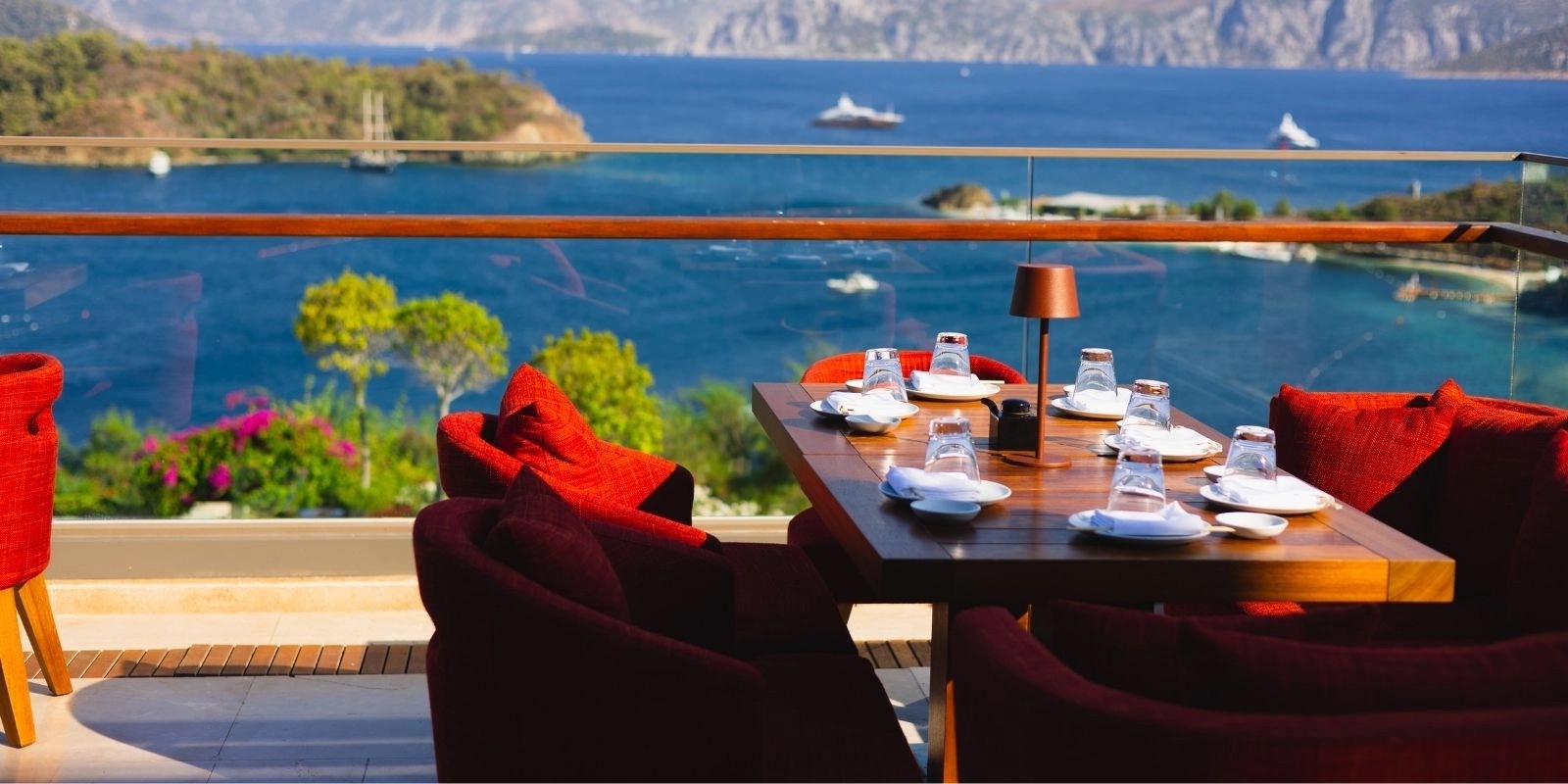
Türkbükü gets right what Yalıkavak got wrong: it kept the bay smaller than the demand. There is no marina; the boats anchor and use tenders. The platforms on the water, Maçakızı, Lacivert, Ayla, are old enough to have a fixed seating geometry that the bay simply has not allowed to expand. The road in is the same road it was twenty years ago, and the village above it has not been rebuilt around the iskele economy. The result, for the older crowd, is that a Türkbükü day still has the pacing it had in 2005. Morning swim from the rocks below Maçakızı before the first guests arrive. Long lunch on a platform between one and four. The five-to-seven golden hour that the bay does as well as anywhere on the Mediterranean. Dinner at Lacivert under the bougainvillea or at Ayla on the Maçakızı hill. None of this requires a queue, a valet or a security check at the gate.
The food axis confirms the pattern. Yalıkavak's serious cooking is now concentrated in the inland and the cove, Mezra fifteen minutes inland, Miços and Hasan's on Tilkicik. The marina is for sushi, Italian and after-hours. Türkbükü's serious cooking sits inside the bay itself: Lacivert and Maçakızı for the long Aegean format, Ayla for the contemporary register, Galia for the daytime swim-and-eat that the bay invented. The inversion is the whole story. In Yalıkavak, you leave the marina to eat properly. In Türkbükü, the bay itself is the room. The older summer family has thirty years of stored capital, practical, social, structural, invested in not having to leave the bay, and Türkbükü still rewards that capital in a way Yalıkavak no longer does.
The crowd shift has tightened the booking pattern across the season. The Türkbükü iskeles now run two seatings on August nights for lunch as well as dinner, and the platforms book three weeks ahead even on a Tuesday. The boats arrive earlier, first ones tying up at Maçakızı by eleven instead of twelve-thirty, and the after-midnight scene at Scorpios is genuinely the room everyone in the bay ends up at by one a.m., not the imported-DJ destination it could easily have become. The bay's discipline has held because the platforms refuse to expand the seating geometry; the rooms are the size they were a decade ago. That refusal is the structural reason the older crowd has not moved on.
What this means in practice for someone planning a Bodrum week is concrete. If you are going for the marina experience, the chef-name rooms, the after-hours, the boat-to-club pipeline, Yalıkavak is still the address. If you are going for what the older Bodrum families consider an actual Bodrum summer, the swim, the long lunch, the slow dinner, the same bay holding the whole day, Türkbükü is the answer, and the answer is more conclusive than it has been at any point in the last decade. The ten-night trip that does six in Türkbükü and two in Yalıkavak (one for Mezra, one for Tilkicik) and two in Gümüşlük is currently the dominant pattern among the older summer-house crowd. They are not wrong.
The implicit lesson is the one the marina cannot say out loud. Bodrum's value to the people who own land in the bay was never the imported chef or the new opening; it was the bay itself, organised around the rooms that have held it for two or three decades. Yalıkavak made the choice, implicitly, through capacity and speed, to chase the volume. Türkbükü has so far made the opposite choice, and the older crowd's preference is the simple consequence of that. If Türkbükü ever capitulates and lets the platforms expand, the same crowd will move again, probably back to Gümüşlük, possibly out to the smaller coves of the eastern peninsula. For now, the eastern axis still works. Use it while it does.